
Last updated July 7, 2026
The Complete Guide to Gate Repair in Bell
A Bell homeowner replaced their gate motor twice in 18 months. The motor was never the problem — a post had shifted 3/8 of an inch, and the misalignment was burning through motors like fuses. We’ve seen this exact scenario in Bell more times than we can count, and it’s why we wrote this guide. Most gate problems in this city trace back to three root causes: foundation settlement from our clay-heavy soil, coastal-adjacent humidity that corrodes electrical components, and operator abuse from forcing a gate that’s already struggling. Understanding which one you’re dealing with changes everything about how you fix it — and how much you spend.
Quick Answer
Gate repair in Bell typically costs between $150 for minor electrical adjustments and $1,200+ for structural welding and post resetting. Most residential repairs fall in the $280–$650 range and are completed same-day by a specialist who can diagnose whether you’re facing an electrical fault, mechanical wear, or structural shift — the three categories that determine your actual fix.
Table of Contents
- Why Gates Fail in Bell: The Three Root Causes
- Electrical vs. Mechanical vs. Structural: Knowing the Difference
- Common Gate Problems and What They Actually Cost to Fix
- How Bell’s Soil and Block Construction Affect Gate Posts
- What’s Safe to Check Yourself vs. What Requires a Brand-Specialist Technician
- Repair or Replace? A Decision Tree for Bell Homeowners
- What a Gate-Only Specialist Checks That Others Skip
- How to Choose a Gate Repair Technician in Bell
Why Gates Fail in Bell: The Three Root Causes
After eight years working exclusively on gate systems across Bell and surrounding cities, we’ve identified three patterns that explain about 85% of the calls we get. These aren’t random breakdowns — they’re predictable failures driven by local conditions and how people use their gates.
Foundation settlement from clay-heavy soil. Bell sits on the edge of the Los Angeles Basin’s alluvial floodplain, with soil that expands when wet and contracts during dry spells. That seasonal movement doesn’t just crack patios — it slowly tilts gate posts, misaligns hinges, and puts twisting stress on automatic operators. In the older neighborhoods near Bell’s eastern edge, we’ve measured post shifts of a quarter-inch to over an inch that went unnoticed until the gate motor started clicking or grinding.
Coastal-adjacent humidity and salt air. We’re not right on the beach, but Bell gets enough marine layer influence — especially during May and June — that moisture penetrates control boxes, corrodes circuit boards, and degrades limit switches faster than in inland cities like Riverside or San Bernardino. We’ve opened control boxes in Bell that looked fine from the outside but had green corrosion on every terminal inside. That corrosion causes intermittent faults: the gate works fine at 10 a.m., won’t respond at 6 p.m., and the homeowner thinks it’s a remote problem.
Operator abuse from forcing a struggling gate. When a gate starts dragging, sticking, or making noise, the natural response is to hit the button again, hold it longer, or manually push it. That overloads the motor, strips nylon gears, and burns out capacitors. The gate “breaks” — but the motor failure is a symptom, not the disease. We’ve replaced three LiftMaster operators in Bell that were perfectly good units destroyed by a misaligned track the homeowner had been forcing for months.
Here’s how these three causes map to what you’ll observe:
- Gate starts fine, then stops mid-travel or reverses: Usually electrical — limit switch, safety sensor, or control board issue, often humidity-related.
- Gate makes grinding noise, moves slowly, or needs a push: Usually mechanical — rollers, hinges, chain/belt wear, or track obstruction.
- Gate rubs at one corner, gap changes seasonally, or operator keeps “losing” its closed position: Usually structural — post shift, frame twist, or foundation settlement.
Getting the category right saves you from the $400 motor replacement that doesn’t fix a $200 post adjustment, or the $800 “new gate” quote when a $350 welding repair would have solved it.
Electrical vs. Mechanical vs. Structural: Knowing the Difference
This distinction matters because each category requires different tools, different expertise, and different pricing. A technician who only knows electrical troubleshooting will sell you a new control board when your post has shifted. A welder who doesn’t understand gate operators will straighten your frame but leave the motor calibrated for the old alignment.
Electrical faults involve power supply, control boards, safety devices, and motor windings. In Bell, we see these most often in systems 5–12 years old where moisture has finally compromised a connection. Typical fixes: replacing a transformer ($180–$260), swapping a failed circuit board ($320–$480 depending on brand), or rewiring a safety loop that keeps throwing false obstruction signals ($150–$220). DoorKing and Elite systems have particularly sensitive loop detectors that fail gradually — the gate “nearly” closes, pauses, then opens again, and homeowners blame the remote.
Mechanical faults are physical wear: chain stretch, sprocket wear, roller deterioration, hinge seizing, or track damage. These develop predictably based on cycle count. A residential gate in Bell cycling 6–8 times daily hits meaningful wear around year 7–10. Commercial gates with 50+ daily cycles may need roller and chain service every 2–3 years. Typical fixes: chain replacement ($200–$340), roller and hinge rebuild ($180–$320), or track realignment ($150–$280).
Structural faults are the most misdiagnosed because they masquerade as electrical or mechanical problems. A post that tilts 1/2 inch toward the street changes the gate’s swing geometry. The operator now sees higher resistance, interprets it as an obstruction, and either reverses or stalls. The homeowner calls for “motor repair.” We check the motor first — it’s fine. Then we measure post plumb with a 4-foot level and find the real issue. Typical fixes: post resetting with concrete reconstruction ($450–$780), frame welding ($280–$520), or full post replacement with deeper footing ($680–$1,200).
Our diagnostic process follows a specific sequence:
- Visual structural check: Post plumb, frame square, hinge alignment, track level — before touching any electrical component.
- Manual operation test: Disconnect the operator and move the gate by hand. Should glide freely with one finger. Resistance here means mechanical or structural, not electrical.
- Electrical isolation: Test power at the board, board output to motor, motor amp draw under load, and all safety device function.
- Brand-specific diagnostics: Each manufacturer — LiftMaster, FAAC, BFT, Linear, Viking, Ghost Controls, DoorKing, Elite, Mighty Mule — has proprietary error codes and calibration procedures. We carry software tools and manuals for all nine.
Skipping step 1 or 2 is how general handymen burn through your money. We’ve arrived at Bell jobs where the previous “technician” had replaced two motors and a control board on a gate with a 3/4-inch post lean that was obvious to a level.
Common Gate Problems and What They Actually Cost to Fix
Here’s what we charge for the repairs we perform most often in Bell. These are our actual 2024–2025 price ranges — not national averages, not estimates from a franchise estimator who hasn’t seen your gate.
| Problem | Typical Cause | Our Price Range | Time to Complete |
|---|---|---|---|
| Gate won’t respond to remote or keypad | Dead transformer, failed receiver, or corroded antenna | $150–$280 | 1–2 hours |
| Gate starts, then reverses immediately | Misaligned safety photo eyes or dirty lens | $120–$180 | 45 min–1 hour |
| Gate moves slowly or labors | Worn rollers, dry hinges, or failing motor capacitor | $180–$340 | 1.5–2.5 hours |
| Gate hits closed position, then reopens | Limit switch drift or mechanical stop damage | $160–$260 | 1–1.5 hours |
| Grinding or squealing noise | Dry chain, worn sprocket, or failing gearbox | $200–$420 | 1.5–3 hours |
| Gate visibly sagging or rubbing ground | Hinge wear or post settlement | $220–$580 | 2–4 hours |
| Post loosened or tilting | Soil movement, shallow footing, or decay | $450–$780 | 3–5 hours |
| Broken or cracked metal frame | Impact damage or metal fatigue | $280–$620 | 2–4 hours |
| Complete operator replacement | Irreparable motor, obsolete parts, or repeated overload failure | $680–$1,400 | 3–5 hours |
These prices include our trip charge within Bell, diagnostic time, parts, and labor. We don’t quote one price over the phone and surprise you with “additional fees” on arrival. If we find something unexpected during diagnosis — a cracked weld we couldn’t see, a post that’s hollow from rust — we stop and explain before proceeding.
Two pricing notes specific to Bell: First, many homes here have side-yard gates on narrow passages between the house and block wall. These tight spaces add 30–60 minutes to welding and post work because we can’t position equipment ideally. Second, if your gate connects to a Mighty Mule or other DIY-installed operator, we sometimes find undersized transformers, inadequate gauge wiring, or missing safety devices that need correction before we can warranty our repair. We flag these during diagnosis, not after.
How Bell’s Soil and Block Construction Affect Gate Posts
This is the section competitors skip because it requires actual local knowledge. Bell’s building stock is distinctive — much of it constructed between the 1920s and 1960s with concrete block perimeter walls and gates hung from steel or iron posts set directly into those walls or into separate concrete footings. That construction style creates specific failure modes.
The block wall gate post. Many Bell properties have gates hung from a steel post that’s embedded in or bolted to a concrete block wall. The wall itself becomes the “foundation.” When that wall settles or tilts — common on the east side of Bell where soil is softer and older drainage is poor — the gate post moves with it. You can’t fix the gate without addressing the wall, and you can’t address the wall without understanding whether it’s a footing issue or a soil issue. We’ve worked with structural masons on complex cases, but for most residential gates, we can install an independent post with its own pier footing that bypasses the wall movement entirely.
The freestanding post with shallow footing. Gates installed in the 1980s–2000s often have steel posts in concrete piers 18–24 inches deep. That’s adequate for a manually operated gate in stable soil. Add an automatic operator with 500+ pounds of closing force, cycle it 2,000 times yearly, and put it in Bell’s expanding-contracting clay — that footing starts to work loose. We’ve reset posts with 36-inch deep piers and added steel reinforcement, and the gates stay plumb for years.
Corrosion at the concrete-air interface. This is a subtle one. Steel posts corrode fastest right at ground level, where moisture, oxygen, and salt from soil meet. In Bell, with our winter rains and summer irrigation, that corrosion zone is active year-round. We’ve cut open posts that looked solid above ground but were paper-thin at the base. Our welding repair includes extending the post with new steel and sometimes adding a protective collar or upgrading to galvanized Schedule 40 pipe.
If you’re in the neighborhoods near Gage Avenue or along the I-710 corridor, we’ve noticed slightly faster post corrosion — possibly from higher groundwater or older fill soil. We inspect for this specifically on initial service calls in those areas.
What’s Safe to Check Yourself vs. What Requires a Brand-Specialist Technician
We’re not going to pretend every gate problem needs us. Some checks are safe, sensible, and will save you a service call. Others will waste your Saturday and possibly damage equipment or injure you.
Safe to check yourself:
- Power at the outlet: Plug a lamp into the operator’s outlet. If no power, check your breaker — especially after rain, when GFCI outlets trip.
- Photo eye alignment: Look for steady LED lights on both sides. If one is blinking or dark, clean the lens with a soft cloth and check for spider webs, leaf debris, or a knocked bracket. These are the #1 cause of “gate won’t close” calls we get in Bell, and they’re free to fix.
- Manual release: Every automatic gate has a manual release — key, lever, or pull cord. Know where yours is and test it quarterly. If the power’s out or the operator fails, this is how you get your car out.
- Visual obstruction: Stones in the track, a plant growing into the swing path, a child’s toy under the gate. Obvious, but we still find them.
Leave to a professional:
- Anything involving the operator’s internal electronics: Control boards carry lethal voltage even when “unplugged” — capacitors hold charge. Plus, misdiagnosing a board failure versus a wiring fault requires brand-specific knowledge. We’ve seen homeowners replace a $400 Elite board when the problem was a $12 fuse.
- Spring-assisted or counterbalanced gates: These store significant mechanical energy. Improper handling can cause uncontrolled gate movement. We’ve treated lacerations from DIY spring work — not worth it.
- Welding or cutting on the gate frame: Structural repairs affect gate weight, balance, and operator loading. We recalibrate operators after welding because the gate’s dynamics change.
- Programming access codes, remotes, or smartphone apps: Sounds simple, but modern systems — especially LiftMaster MyQ and DoorKing cellular controllers — have security protocols that lock out after failed attempts. We’ve been called to “unbrick” systems after DIY programming attempts.
Our rule: if you’ve checked the obvious (power, eyes, obstructions) and the gate still malfunctions, call before you start disassembling. The diagnostic fee is usually less than the cost of a part you didn’t need, installed wrong.
Repair or Replace? A Decision Tree for Bell Homeowners
This is the question we get most often after diagnosis: “Should we fix this or start over?” Here’s how we guide that decision, based on eight years of seeing which choices work out long-term.
Repair when:
- The gate frame and posts are structurally sound — no cracks, no significant rust, no movement beyond 1/4 inch.
- The operator is less than 10 years old and parts are available for your brand. We stock parts for all nine brands we service, but some older Mighty Mule and early Ghost Controls units are becoming obsolete.
- This is the first or second significant repair. A gate that’s needed three major repairs in four years is telling you something.
- The repair cost is under 40% of replacement. Our threshold: if fixing it costs more than $1,200 and a new comparable system is $2,800, we start talking about replacement.
Replace when:
- The frame has multiple cracks, severe rust, or has been welded more than twice. Each weld changes the metal’s properties; a gate that’s “all welds” has no structural integrity left.
- The posts are rotted at ground level, extensively corroded, or moving independently of their footings. Post replacement often requires gate removal anyway — you’re halfway to a new system.
- The operator is obsolete, parts unavailable, or has been overloaded by an underlying structural problem we can’t fully correct. Installing new electronics on a compromised structure just burns another motor.
- You need functionality the current system can’t provide: higher security (anti-tailgating, loop detection), smartphone control, integration with cameras, or ADA-compliant access timing.
In Bell specifically, we factor in soil stability. If your post has shifted once and we’ve addressed it with a deeper pier, repair makes sense. If the whole property perimeter is moving — cracks in the driveway, tilting block walls, doors that stick seasonally — that’s a geotechnical issue no single gate repair solves. We fix the gate, but we also tell you it’ll need monitoring.
What a Gate-Only Specialist Checks That Others Skip
This is where our eight years of single-trade focus shows up in your result. When we arrive at a Bell home, we run through a checklist that general handymen, franchise dispatchers, and “we do everything” contractors typically miss.
Post plumb and footing inspection. We carry a 4-foot level and a tape measure on every call. We check post vertical in two planes and compare to our photos from any prior service. A shift of 1/8 inch matters — we catch it before it becomes 1/2 inch.
Gate balance and weight. Disconnect the operator, open the gate manually to 90 degrees, and release. A properly balanced gate stays put or drifts slowly. A gate that falls open or closed is out of balance — usually hinge wear or frame twist — and will destroy any operator over time.
Operator duty cycle and thermal history. We check the operator’s duty cycle rating against actual use. A residential LiftMaster rated for 20 cycles per hour in 70°F weather will overheat in Bell’s August afternoons at 50+ cycles. If your usage exceeds rating, we recommend upgrading before the motor fails.
Safety device function beyond “it works.” We test force sensitivity with a calibrated gauge, not just “it stopped when I waved my hand.” California building code requires specific force limits; we verify compliance because liability falls on the property owner if someone gets injured.
Brand-specific error code history. Modern operators log faults. We extract that history — a 30-second procedure with the right software cable — and see patterns: “Overcurrent on close, 47 times in 3 months.” That tells us the story the homeowner couldn’t.
Weld quality of previous repairs. We’ve found gates in Bell with welds that looked okay but were actually surface tacks with no penetration — fine until someone leans on the gate or the wind loads it. We grind and re-weld these properly, in-house, same visit.
Generalists don’t have time for this depth. They’re scheduled for four jobs today, gates are 10% of their business, and they’re moving on to the next handyman call. We’re not criticizing — it’s just economics. But your gate is 100% of our business, and it shows in what we find and fix.
How to Choose a Gate Repair Technician in Bell
If you’re reading this and haven’t called us yet, here’s what to verify before you hire anyone — including us.
Ask: “What brands are you trained on?” If the answer is “all of them” or a vague “we work on everything,” that’s a red flag. Gate operators are not generic. A technician who knows FAAC hydraulic systems but has never touched Viking electromechanical hardware will guess at your problem. We list our nine brands openly because specificity builds trust.
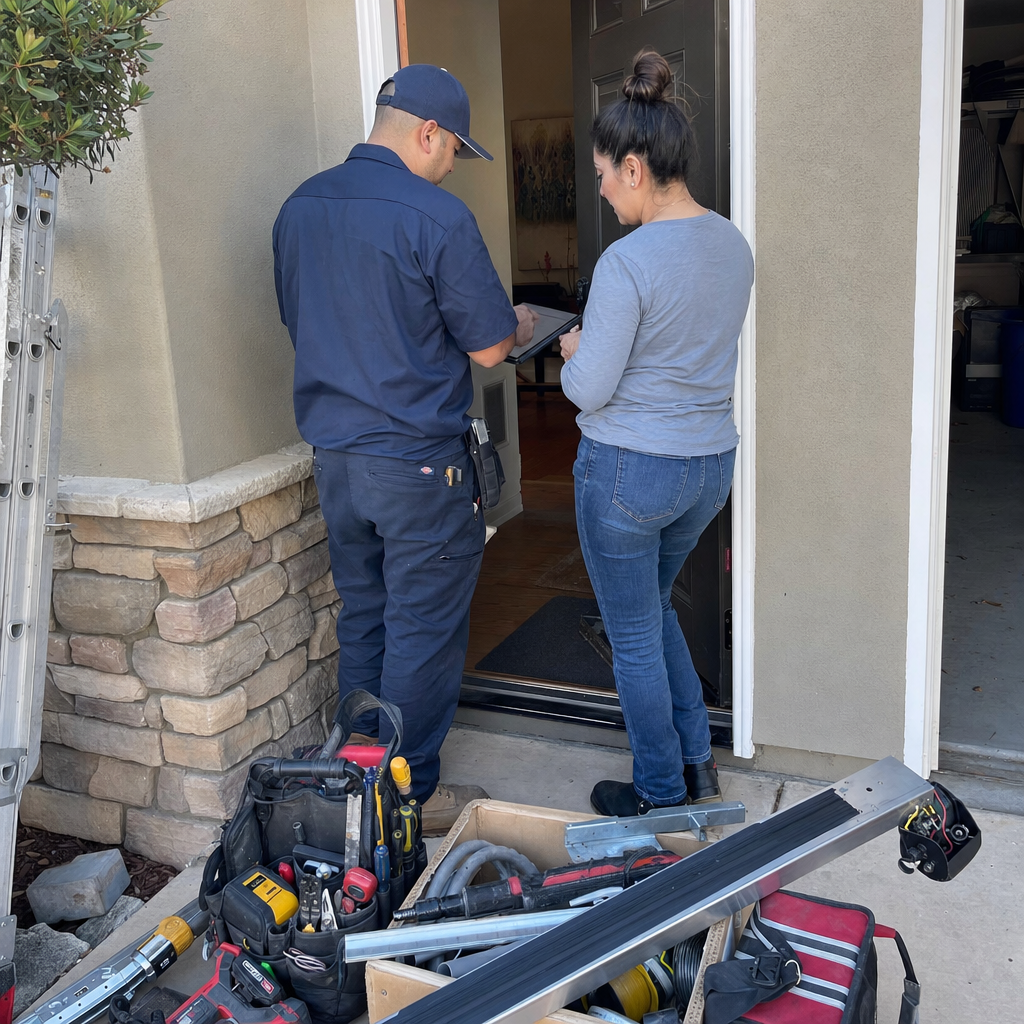
Ask: “Will you be the one doing the work?” Franchise operations and large home-service companies often send a salesperson to quote, then a different technician to execute, sometimes a subcontractor you’ve never met. At Guardian Gate Repair Service Los Angeles, Daniel Lopez owns the business and leads every service call. You know exactly who’s showing up — and what they’ve fixed before.
Ask: “Can you weld on-site?” If they can’t, any structural repair gets referred out, adding days and disconnecting accountability. We carry a 220V welding rig and cut, grind, and weld steel and iron gate components in your driveway.
Ask: “What’s your diagnostic process?” A technician who starts by quoting a new motor before testing is selling, not diagnosing. Our process — structural, mechanical, electrical, brand-specific — is described above. Anyone worth hiring should be able to explain theirs clearly.
Check reviews for gate-specific depth. Look for mentions of your brand, your type of problem, or technical details. “Fixed my gate” tells you nothing. “Diagnosed a DoorKing loop detector fault and reset my post after it shifted” tells you they know the work. Our 250 reviews averaging 4.8 stars include specifics because our customers notice the difference.
We also service neighboring Gate Repair in Bell Gardens, Gate Installation in Bell Gardens, and Gate Motor & Opener in Bell Gardens — the same expertise, the same technician.
Common Mistakes to Avoid
- Replacing the motor without checking post alignment. We’ve seen $1,200 in unnecessary motor replacements in Bell because no one measured whether the gate was actually square in its opening. Always verify structure before electronics.
- Ignoring seasonal changes. If your gate worked fine in October but sticks in March, that’s not “random” — it’s soil moisture expansion. Address the drainage or post footing, not just the symptom.
- Buying “universal” replacement parts online. That $89 “fits all brands” control board from an e-commerce site rarely fits your mounting pattern, voltage requirements, or safety protocol. We’ve been called to remove these and install proper manufacturer parts.
- Skipping the manual release test. Every homeowner should know how to disengage their operator manually. During Bell’s occasional power outages or fire-season PSPS events, this knowledge gets your vehicle out.
- Hiring based on lowest phone quote. A $99 “service call” that doesn’t include diagnosis, that adds trip charges, or that discovers “unexpected problems” at 3x the estimate isn’t cheaper — it’s just structured to get a foot in the door.
- Neglecting safety device function. California property liability is strict. If your auto-reverse fails and someone gets injured, “I didn’t know” isn’t a defense. Test monthly, document annually.
- Assuming all welding is equal. We’ve cut apart “repaired” gates where the previous welder had simply laid bead over rust. Proper repair requires grinding to clean metal, correct rod or wire selection for the base metal, and post-weld protection.
When to Call a Professional
Call when the gate won’t open and you need to leave for work. Call when you’ve checked the obvious and something still isn’t right. Call when you’re considering a major repair and want a second opinion on whether replacement makes more sense. Call when your gate has hit something, made a new noise, or started behaving differently — these changes are data, and catching them early prevents the catastrophic failure that costs double.
Guardian Gate Repair Service Los Angeles offers free estimates in Bell — call (877) 283-1729. Daniel Lopez will walk through what you’re seeing, ask the questions that narrow the diagnosis, and schedule a time that works. Most Bell repairs are same-day or next-day, and you’ll know the full price before we start any work.
Frequently Asked Questions
Most residential gate repairs in Bell fall between $280 and $650, with simple electrical fixes like photo eye realignment starting around $120 and structural welding or post resetting reaching $780 or more. Commercial systems with heavier hardware or access control integration typically run higher. Call (877) 283-1729 for a free, exact quote based on your specific gate and problem — estimates are free, and we don’t charge until you approve the work.
Yes, approximately 80% of our Bell service calls are completed same-day, including most electrical, mechanical, and welding repairs. We stock parts for all nine brands we service — LiftMaster, FAAC, BFT, Linear, Viking, Ghost Controls, DoorKing, Elite, and Mighty Mule — and carry welding equipment for structural repairs. Full gate replacement or custom fabrication requires measurement and ordering, typically 1–2 weeks. Call (877) 283-1729 to check same-day availability.
This is almost always a safety device issue: misaligned photo eyes, a dirty lens, or a failed edge sensor. Less commonly, it’s a mechanical obstruction or a control board interpreting normal resistance as an obstruction. Check that both photo eye LEDs are steady (not blinking), clean the lenses, and remove any debris in the gate path. If the problem persists, the limit switches may need recalibration or the board may have a fault — both require brand-specific diagnostic tools. Call (877) 283-1729 and we’ll isolate the cause in about 20 minutes.
Repair is cheaper when the frame and posts are sound, the operator is under 10 years old with available parts, and this is your first or second major repair. Replacement becomes the better investment when the frame has multiple cracks or prior welds, posts are rotted or moving, parts are obsolete, or repair costs exceed 40% of a new system. We’ve guided Bell homeowners both ways based on honest assessment, not sales pressure. Call (877) 283-1729 for an evaluation of your specific situation.
We service nine major brands: LiftMaster, FAAC, BFT, Linear, Viking, Ghost Controls, DoorKing, Elite, and Mighty Mule. This covers the vast majority of residential and light commercial systems installed in Bell over the past 20 years. We carry diagnostic software, programming tools, and common failure parts for all nine. If you have a rare or obsolete brand, we’ll tell you honestly whether we can source parts or if replacement is the practical option.
Bell’s combination of clay-heavy, settlement-prone soil, coastal-influenced humidity that accelerates electrical corrosion, and a housing stock with block-wall-integrated gate posts creates specific failure patterns we don’t see identically elsewhere. We’ve developed repair techniques — deeper post footings, corrosion-resistant post collars, humidity-sealed control box upgrades — specifically for these conditions. Eight years of Bell-specific work means we recognize your problem faster and fix it more durably than a technician who treats every city the same.
The Bottom Line
Gate problems in Bell aren’t mysterious — they’re predictable consequences of local soil, climate, and usage patterns, made worse when symptoms get misdiagnosed and the wrong components get replaced. The homeowner who understands whether they’re facing an electrical, mechanical, or structural fault saves money, avoids repeat failures, and gets a gate that actually stays fixed. That’s what this guide is built for: giving you the knowledge to ask better questions, spot superficial fixes, and choose a technician who diagnoses root causes instead of swapping parts. If that technician is us, you’ll get Daniel Lopez on your property, eight years of gate-only expertise, and a repair that’s done right the first time.
Ready to get your gate working properly? Call Guardian Gate Repair Service Los Angeles at (877) 283-1729 for a free estimate in Bell. We’ll diagnose your gate, explain exactly what’s wrong and why, and give you a fixed price before any work begins. Same-day service available for most repairs.
Written by Daniel Lopez, Owner & Lead Technician at Guardian Gate Repair Service Los Angeles, serving Bell since 2018.